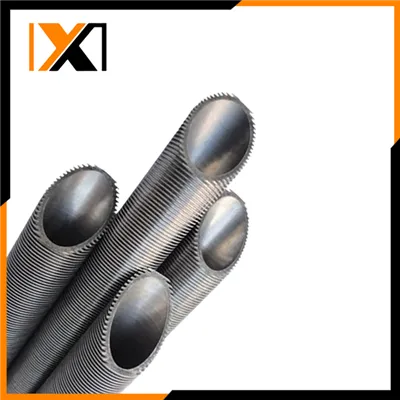
What is the heat transfer area of copper high performance fin tube?
As a supplier of copper high performance fin tubes, I am often asked about the heat transfer area of these tubes. Understanding the heat transfer area is crucial for various applications, including HVAC systems, refrigeration units, and industrial heat exchangers. In this blog post, I will delve into the concept of heat transfer area in copper high performance fin tubes, explain how it is calculated, and discuss its significance in enhancing heat transfer efficiency.
Understanding the Basics of Heat Transfer
Before we dive into the heat transfer area of copper high performance fin tubes, let's briefly review the fundamentals of heat transfer. Heat transfer occurs through three main mechanisms: conduction, convection, and radiation. In most practical applications, conduction and convection are the dominant modes of heat transfer.
Conduction is the transfer of heat through a solid material, such as a copper tube. The rate of conduction depends on the thermal conductivity of the material, the temperature difference across the material, and the cross-sectional area through which the heat is flowing.
Convection is the transfer of heat between a solid surface and a fluid (liquid or gas) in motion. The rate of convection depends on the fluid velocity, the temperature difference between the surface and the fluid, and the surface area available for heat transfer.
In a heat exchanger, the goal is to maximize the rate of heat transfer between two fluids (e.g., hot and cold water) or between a fluid and a solid surface (e.g., a refrigerant and a copper tube). One way to achieve this is by increasing the surface area available for heat transfer. This is where copper high performance fin tubes come into play.
What are Copper High Performance Fin Tubes?
Copper high performance fin tubes are specialized tubes that have fins attached to their outer surface. These fins increase the surface area of the tube, thereby enhancing the rate of heat transfer between the fluid inside the tube and the fluid outside the tube.
The fins can be made of the same material as the tube (e.g., copper) or a different material with high thermal conductivity (e.g., aluminum). They can have various shapes and sizes, depending on the specific application requirements. Some common fin shapes include rectangular, triangular, and circular.
Compared to smooth surface copper tubes, copper high performance fin tubes offer several advantages. They provide a larger surface area for heat transfer, which results in higher heat transfer coefficients and improved energy efficiency. They also help to reduce the size and cost of the heat exchanger, as less tube length is required to achieve the same heat transfer rate.
Calculating the Heat Transfer Area of Copper High Performance Fin Tubes
The heat transfer area of a copper high performance fin tube is the sum of the outer surface area of the tube and the surface area of the fins. To calculate the heat transfer area, we need to consider the following factors:
-
Tube Diameter and Length: The outer diameter and length of the tube determine the outer surface area of the tube without the fins. The formula for the outer surface area of a cylinder is (A_{tube}=\pi D L), where (D) is the outer diameter of the tube and (L) is the length of the tube.
-
Fin Dimensions: The dimensions of the fins, including their height, thickness, and pitch (distance between adjacent fins), affect the surface area of the fins. The formula for the surface area of a single fin depends on its shape. For example, the surface area of a rectangular fin can be calculated as (A_{fin}=2\times (h\times t + h\times p)), where (h) is the height of the fin, (t) is the thickness of the fin, and (p) is the pitch of the fin.
-
Number of Fins: The number of fins per unit length of the tube also affects the total surface area of the fins. The total number of fins on the tube can be calculated as (N = \frac{L}{p}), where (L) is the length of the tube and (p) is the pitch of the fin.
-
Fin Efficiency: In reality, not all of the fin surface area contributes equally to heat transfer. The fin efficiency is a measure of how effectively the fin transfers heat from the base of the fin to the tip of the fin. The fin efficiency depends on the fin material, fin shape, fin dimensions, and the heat transfer coefficient between the fin and the surrounding fluid.
To calculate the total heat transfer area of a copper high performance fin tube, we first calculate the outer surface area of the tube without the fins ((A_{tube})), then calculate the total surface area of the fins ((A_{fins})), and finally add them together. The formula for the total heat transfer area ((A_{total})) is:
(A_{total}=A_{tube}+A_{fins})
where (A_{fins}=N\times A_{fin}\times \eta_{fin}), and (\eta_{fin}) is the fin efficiency.
Significance of Heat Transfer Area in Copper High Performance Fin Tubes
The heat transfer area of copper high performance fin tubes plays a crucial role in determining the performance and efficiency of heat exchangers. A larger heat transfer area allows for more heat to be transferred between the fluids, which results in higher heat transfer rates and improved energy efficiency.
In HVAC systems, for example, copper high performance fin tubes are used in air handling units, condensers, and evaporators. By increasing the heat transfer area, these tubes can help to improve the cooling and heating capacity of the system, reduce energy consumption, and lower operating costs.
In refrigeration units, copper high performance fin tubes are used in condensers and evaporators to transfer heat between the refrigerant and the surrounding air or water. A larger heat transfer area can help to improve the refrigeration efficiency, reduce the compressor power consumption, and extend the lifespan of the unit.
In industrial heat exchangers, copper high performance fin tubes are used to transfer heat between different fluids in various processes, such as chemical reactions, power generation, and food processing. By increasing the heat transfer area, these tubes can help to improve the process efficiency, reduce the energy requirements, and enhance the overall productivity of the plant.
Related Products
In addition to copper high performance fin tubes, we also offer a range of other copper tubes, including Copper Corrugated Tube, Smooth Surface Copper Tube in Coil, and Copper Ordinary Low Fin Tube. These products are designed to meet the diverse needs of our customers in different industries.
Contact Us for Purchase and Negotiation
If you are interested in our copper high performance fin tubes or any of our other products, please feel free to contact us for purchase and negotiation. We have a team of experienced professionals who can provide you with detailed product information, technical support, and competitive pricing.
We are committed to providing high-quality products and excellent customer service. Whether you are a small business or a large corporation, we can work with you to meet your specific requirements and help you achieve your goals.


References
- Incropera, F. P., & DeWitt, D. P. (2002). Fundamentals of Heat and Mass Transfer. John Wiley & Sons.
- Holman, J. P. (2002). Heat Transfer. McGraw-Hill.
- Kakac, S., & Liu, H. (2002). Heat Exchangers: Selection, Rating, and Thermal Design. CRC Press.