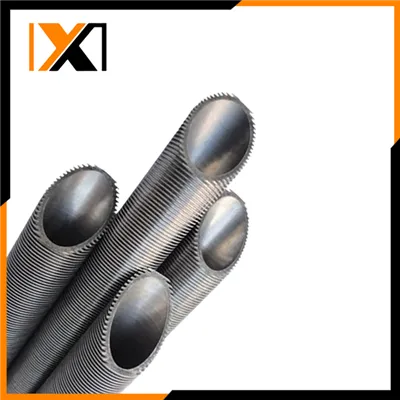
The heat transfer coefficient is a crucial parameter in assessing the thermal performance of heat transfer equipment. When it comes to the copper ordinary low fin tube, understanding its heat transfer coefficient is essential for both engineers and end - users in various industries. As a supplier of copper ordinary low fin tubes, I am well - versed in the technical aspects of these products and eager to share in - depth knowledge about their heat transfer coefficients.


Understanding the Basics of Heat Transfer Coefficient
The heat transfer coefficient, denoted as (h), represents the quantity of heat transferred per unit area per unit temperature difference between the fluid and the surface. It is measured in (W/(m^{2}\cdot K)). A higher heat transfer coefficient indicates that the material can transfer heat more efficiently. For a copper ordinary low fin tube, the heat transfer coefficient is influenced by multiple factors, including the tube's geometry, the properties of the working fluid, and the flow conditions.
Factors Affecting the Heat Transfer Coefficient of Copper Ordinary Low Fin Tubes
Geometric Factors
The design of the low fin tube plays a significant role in determining its heat transfer coefficient. The fins on the tube increase the surface area available for heat transfer. The height, pitch, and thickness of the fins are key geometric parameters. A greater fin height generally leads to an increased surface area, which can enhance the heat transfer rate. However, if the fin height is too large, it may cause a decrease in the heat transfer coefficient due to increased flow resistance and non - uniform flow distribution. The fin pitch also affects the heat transfer. A smaller fin pitch can increase the surface area per unit length of the tube, but it may also lead to flow blockage and reduced heat transfer efficiency under certain flow conditions.
Fluid Properties
The properties of the fluid flowing inside and outside the tube have a profound impact on the heat transfer coefficient. The thermal conductivity, density, specific heat, and viscosity of the fluid are important factors. For example, fluids with high thermal conductivity can transfer heat more effectively. Water, with its relatively high thermal conductivity, is often used as a working fluid in many heat transfer applications. The flow regime of the fluid, whether it is laminar or turbulent, also affects the heat transfer coefficient. Turbulent flow generally results in a higher heat transfer coefficient compared to laminar flow because it promotes better mixing of the fluid and more efficient heat transfer.
Flow Conditions
The velocity of the fluid flowing through the tube and across the fins is a critical factor. Higher fluid velocities can increase the heat transfer coefficient by reducing the thickness of the boundary layer. The boundary layer is a thin layer of fluid adjacent to the tube surface where the heat transfer resistance is relatively high. By increasing the fluid velocity, the boundary layer is thinned, and heat can be transferred more easily. However, increasing the fluid velocity also leads to an increase in pressure drop, which requires more pumping power.
Measuring the Heat Transfer Coefficient of Copper Ordinary Low Fin Tubes
To accurately measure the heat transfer coefficient of copper ordinary low fin tubes, experimental methods are commonly used. One of the most common experimental setups involves a test rig where the tube is installed, and a fluid is circulated through it. The temperature difference between the inlet and outlet of the fluid, as well as the heat input or output, is measured. By applying the heat transfer equations, the heat transfer coefficient can be calculated.
In addition to experimental methods, numerical simulations can also be used to predict the heat transfer coefficient of copper ordinary low fin tubes. Computational Fluid Dynamics (CFD) software can simulate the fluid flow and heat transfer processes inside and around the tube. These simulations can provide detailed information about the flow field, temperature distribution, and heat transfer coefficient under different operating conditions.
Applications and the Importance of Heat Transfer Coefficient
Copper ordinary low fin tubes are widely used in various heat transfer applications, such as air - conditioning systems, refrigeration systems, and industrial heat exchangers. In air - conditioning systems, the high heat transfer coefficient of these tubes allows for more efficient cooling or heating, which can reduce energy consumption and improve the overall performance of the system. In refrigeration systems, the efficient heat transfer provided by the low fin tubes helps in maintaining the desired temperature and improving the coefficient of performance (COP) of the system.
In industrial heat exchangers, copper ordinary low fin tubes can enhance the heat transfer between different fluids, such as in chemical processes where heat needs to be transferred from a hot fluid to a cold fluid. The high heat transfer coefficient of these tubes can reduce the size of the heat exchanger, saving space and cost.
Comparison with Other Copper Tubes
Compared to plain copper tubes, copper ordinary low fin tubes generally have a higher heat transfer coefficient. The fins on the low fin tubes increase the surface area for heat transfer, which is a significant advantage. When compared to other types of enhanced copper tubes, such as Copper Tube Direct Expansion and Copper Pool Boiling Evaporator Tube, the heat transfer performance of copper ordinary low fin tubes may vary depending on the specific application. For example, in applications where pool boiling is the dominant heat transfer mechanism, copper pool boiling evaporator tubes may have a better heat transfer coefficient. However, in general forced - convection heat transfer applications, copper ordinary low fin tubes are a popular choice due to their good balance between heat transfer performance and cost.
Optimizing the Heat Transfer Coefficient of Copper Ordinary Low Fin Tubes
To optimize the heat transfer coefficient of copper ordinary low fin tubes, several strategies can be adopted. Firstly, optimizing the fin geometry through careful design and manufacturing can improve the heat transfer performance. This may involve adjusting the fin height, pitch, and thickness based on the specific application requirements. Secondly, selecting the appropriate working fluid and flow conditions can also enhance the heat transfer coefficient. For example, adjusting the fluid velocity and temperature to ensure turbulent flow and optimal heat transfer.
Conclusion
As a supplier of Copper Ordinary Low Fin Tube, I understand the importance of the heat transfer coefficient in the performance of these tubes. The heat transfer coefficient of copper ordinary low fin tubes is influenced by multiple factors, including geometric factors, fluid properties, and flow conditions. By understanding these factors and optimizing the tube design and operating conditions, we can provide high - performance copper ordinary low fin tubes to our customers.
If you are interested in our copper ordinary low fin tubes and would like to discuss your specific heat transfer requirements, we invite you to contact us for a detailed procurement discussion. Our team of experts is ready to assist you in selecting the most suitable products for your application.
References
- Incropera, F. P., & DeWitt, D. P. (2002). Fundamentals of Heat and Mass Transfer. John Wiley & Sons.
- Kakaç, S., & Liu, H. (2002). Heat Exchangers: Selection, Rating, and Thermal Design. CRC Press.
- Shah, R. K., & Sekulic, D. P. (2003). Fundamentals of Heat Exchanger Design. John Wiley & Sons.