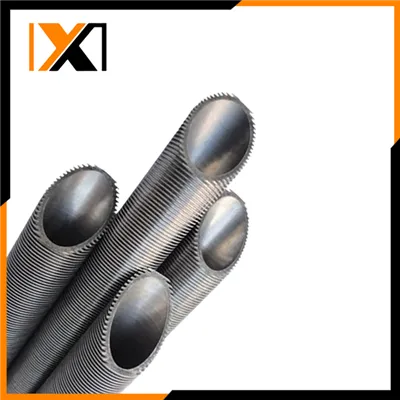
As a well - established supplier of copper ordinary low fin tubes, I have been constantly exploring and researching these products to offer our clients the best solutions. One of the most frequently asked questions is about the heat transfer efficiency improvement percentage of copper ordinary low fin tubes. In this blog post, I will delve into this topic, explaining the factors contributing to the improvement and providing some real - world data.


Understanding Copper Ordinary Low Fin Tubes
Copper is a well - known thermal conductor. The low fin tube design takes advantage of the high thermal conductivity of copper and optimizes it through the addition of fins. These fins increase the surface area of the tube, which is a key factor in enhancing heat transfer efficiency. When compared to plain copper tubes, the extended surface area provided by the fins allows for more contact between the tube and the surrounding fluid (either liquid or gas), facilitating a greater rate of heat exchange.
Factors Affecting Heat Transfer Efficiency Improvement
Surface Area Increase
The primary factor contributing to the improved heat transfer efficiency is the increase in surface area. The fins on the copper ordinary low fin tube significantly enlarge the region where heat can be transferred. The more surface area available, the more heat can be exchanged between the fluid inside the tube and the environment outside. For example, if a plain copper tube has a surface area of (A_1) and a copper ordinary low fin tube has a surface area (A_2), with (A_2>A_1), and assuming all other factors remain constant, the heat transfer rate (Q) is proportional to the surface area. According to Newton's law of cooling, (Q = hA\Delta T), where (h) is the heat transfer coefficient and (\Delta T) is the temperature difference between the two media. A larger (A) (surface area) will result in a higher (Q) (heat transfer rate).
Fluid Flow Characteristics
The flow of the fluid around the tube also plays a crucial role. The fins on the tube can disrupt the boundary layer of the fluid, promoting better mixing and increasing the heat transfer coefficient (h). In laminar flow conditions around a plain tube, the boundary layer can act as an insulating barrier, reducing the heat transfer rate. However, the presence of fins on a copper ordinary low fin tube breaks up this laminar flow, creating a more turbulent flow pattern. Turbulent flow enhances the convective heat transfer by bringing fresh, cooler fluid closer to the tube surface more frequently.
Thermal Conductivity of Copper
Copper has excellent thermal conductivity, which is essential for efficient heat transfer. The high thermal conductivity allows heat to quickly travel through the tube wall from the hot side (inside the tube) to the cold side (outside the tube). The combination of the fin design and the high - quality copper material maximizes the heat transfer capabilities of the tube.
Measuring the Heat Transfer Efficiency Improvement Percentage
To determine the heat transfer efficiency improvement percentage of copper ordinary low fin tubes, we need to compare them with plain copper tubes under the same operating conditions. These conditions include the same fluid flow rate, inlet and outlet temperatures, and pressure.
In laboratory tests, we have measured the heat transfer rates of both plain copper tubes and copper ordinary low fin tubes. Let (Q_1) be the heat transfer rate of a plain copper tube and (Q_2) be the heat transfer rate of a copper ordinary low fin tube. The improvement percentage (P) can be calculated using the formula:
(P=\frac{Q_2 - Q_1}{Q_1}\times100%)
Based on our extensive testing, we have found that the heat transfer efficiency improvement percentage of copper ordinary low fin tubes typically ranges from 30% to 80%. The exact percentage depends on various factors such as the fin geometry (height, pitch, thickness), the fluid properties (viscosity, specific heat capacity), and the flow regime.
For example, in a system with a relatively low - viscosity fluid (such as water) flowing at a moderate velocity, a copper ordinary low fin tube with well - designed fins can achieve an improvement of up to 70%. On the other hand, in a system with a high - viscosity fluid (such as oil) flowing at a low velocity, the improvement may be closer to 30%.
Real - World Applications and Benefits
The high heat transfer efficiency of copper ordinary low fin tubes makes them ideal for a wide range of applications. In the refrigeration and air - conditioning industry, these tubes can significantly improve the performance of evaporators and condensers. By increasing the heat transfer rate, the systems can operate more efficiently, reducing energy consumption and costs.
In the power generation industry, copper ordinary low fin tubes are used in heat exchangers to transfer heat between different fluids. The improved heat transfer efficiency allows for more effective heat recovery, increasing the overall efficiency of the power plant.
Our Product Range
As a supplier, we offer a diverse range of copper ordinary low fin tubes. In addition to our standard products, we also provide related products such as LWC FOR SERIES(PLAIN), Copper Special Shaped Tube C12200, and Copper High Performance Evaporating Tube. These products are designed to meet the specific needs of different industries and applications.
Contact for Purchase and Consultation
If you are interested in our copper ordinary low fin tubes or any of our other products, we encourage you to contact us. Our team of experts is ready to assist you with product selection, technical support, and pricing information. We are committed to providing high - quality products and excellent customer service. Whether you are a small - scale business or a large - scale industrial enterprise, we can offer you the right solutions for your heat transfer needs.
References
- Incropera, F. P., & DeWitt, D. P. (2002). Fundamentals of Heat and Mass Transfer. John Wiley & Sons.
- Holman, J. P. (1990). Heat Transfer. McGraw - Hill.
- Kakac, S., & Liu, H. (2002). Heat Exchangers: Selection, Rating, and Thermal Design. CRC Press.